

The Embodied Foundations and Dissociation Boundary
Lesson Details
This lesson examines the Embodied Foundations Core as the geometric and functional heart of the Mandala, where ontology meets practical application. Students will understand how the four foundations (Nourishment, Cleansing, Restoration, Movement) form the necessary ground for all higher-dimensional transformation and how they relate to the dissociation boundary between individual experience and Mind at Large.

🎙️ Related Podclass
Lesson Content
Embodied Foundations as Ontological Gateway
The Mandala's revolutionary insight lies in its inversion of traditional ontological hierarchies. Rather than beginning with transcendent states or abstract principles, it places four embodied foundations—Nourishment, Cleansing, Restoration, and Movement—at the geometric and functional core from which all other dimensions unfold. This positioning isn't accidental but reflects a profound understanding that all transformation, whether personal or collective, emerges from and depends on physical stability.
The Embodied Foundations Core as Geometric Heart
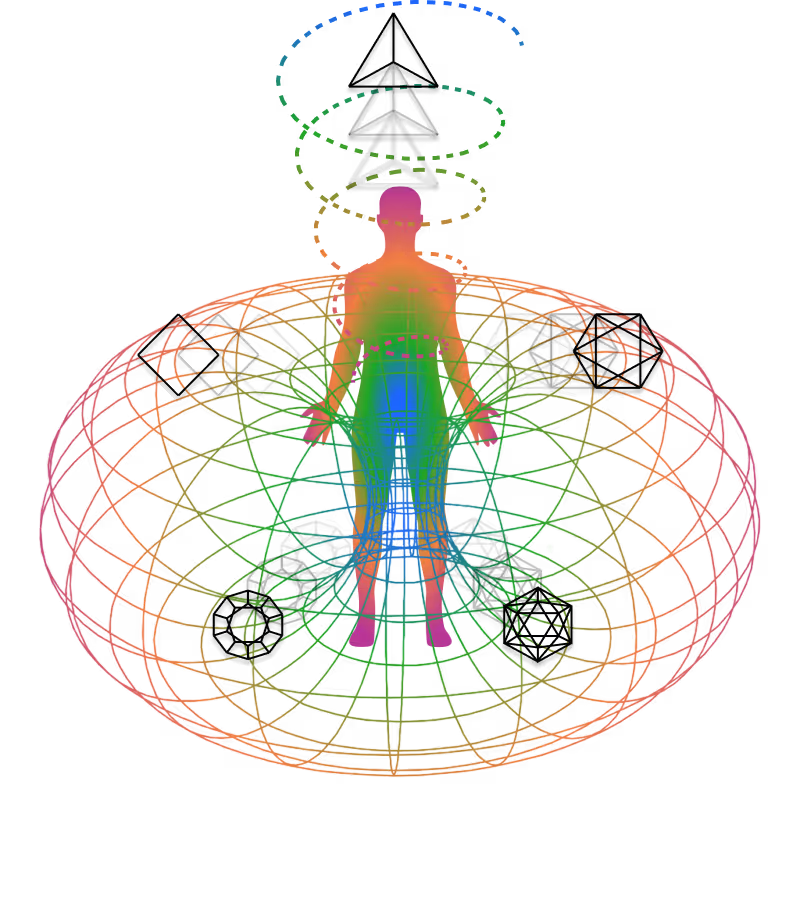
The Embodied Foundations Core (Ø) represents the most radical innovation in the Mandala's architecture. Unlike conventional frameworks that place abstract principles or transcendent states at their center, the Mandala begins with four embodied functions that ground all higher-order transformation. This null point (Ø) is not a perspective but the dissociation boundary itself—where Mind at Large partitions into individual alters with their own boundaries of experience.
Geometrically, this core functions as the singularity point from which all other dimensions emerge. Like the zero point in a coordinate system that enables all other positions to be defined, the Embodied Foundations Core provides the reference point from which consciousness can experience itself as both unified and differentiated. The four foundations operate not as sequential steps but as simultaneous dimensions that must be maintained in dynamic balance. When viewed through the lens of analytic idealism, these foundations represent not merely physical necessities but the very gateway through which MAL becomes accessible to its dissociated expressions.
This geometric placement transforms how we understand the relationship between spiritual and material concerns. Rather than treating embodied needs as "lower" concerns to be transcended, the Mandala recognizes them as the necessary ground for all higher-dimensional work. The framework explicitly warns: "No pathway or protocol can be fully activated when any foundation scores below 2 on a 1-5 scale." This principle isn't arbitrary—it reflects the ontological reality that consciousness requires stable embodiment to express its full potential.
The Four Foundations as Dissociation Healers
Each foundation operates as both a practical necessity and an ontological gateway that heals specific dissociation boundaries. Nourishment addresses the dissociation between consumption and reciprocity; Cleansing heals the boundary between purity and toxicity; Restoration mends the fracture between brokenness and wholeness; Movement dissolves the separation between stillness and flow.
Nourishment as ontological principle represents the cyclical processes of taking in, transforming, and circulating sustenance at individual and collective levels. When fractured, nourishment becomes extraction—taking without giving back, consuming without reciprocating. When integrated, it becomes reciprocity—recognizing that to receive nourishment is to participate in a cosmic exchange where consciousness feeds itself through form. This foundation heals the dissociation between individual survival and collective care, reminding us that no life exists in isolation.
Cleansing encompasses the processes of purification, elimination, and renewal that maintain health at all scales. When fractured, cleansing becomes disposal—pushing waste and toxicity away from awareness. When integrated, it becomes transformation—recognizing that what appears as waste is actually unprocessed potential. This foundation heals the boundary between acceptance and rejection within consciousness, teaching us that nothing needs to be excluded from the field of awareness.
Restoration involves the processes of repair, recovery, and regeneration that heal damage and build resilience. When fractured, restoration becomes extraction of healing labor—demanding that the wounded do the work of healing themselves. When integrated, it becomes mutual care—recognizing that healing is a collective process that honors both brokenness and wholeness. This foundation addresses the boundary between self and other in the field of awareness, teaching us that no one heals alone.
Movement includes the processes of flow, transition, and transformation that enable adaptation and evolution. When fractured, movement becomes forced migration or stagnation—either violent displacement or rigid immobility. When integrated, it becomes graceful adaptation—recognizing that all life exists in dynamic relationship with its environment. This foundation works with the boundary between stillness and change in conscious experience, teaching us that stability and transformation are not opposites but complementary expressions of the same consciousness.
Together, these foundations create what the framework calls the "Dissociation Lens Framework," requiring all practices to answer the core question: "How does this work address the dissociation boundary between individual experience and Mind at Large?" This prevents philosophical-materialist slippage by ensuring that every action, however practical, connects back to the fundamental insight that separation is illusory.
The Embodied Threshold Rule as Protection Against Bypassing
The Embodied Threshold Rule represents one of the framework's most revolutionary insights—its refusal to separate spiritual practice from material conditions. Many consciousness frameworks, whether ancient or contemporary, often collapse into abstraction when faced with real-world challenges like hunger, housing insecurity, or trauma. The Mandala prevents this by establishing a non-negotiable threshold: no pathway or protocol can be fully activated when any foundation scores below 2 on a 1-5 scale.
This threshold creates what the framework calls "boundary medicine"—practices specifically designed to heal the dissociation between spiritual and material domains. For example, when a community faces food insecurity (Nourishment foundation below 2), the framework doesn't offer transcendent meditations as primary intervention but focuses on practical food systems while simultaneously addressing the dissociation between individual survival and collective care. This prevents "philosophical-materialist slippage"—where consciousness frameworks collapse into materialism when confronted with concrete challenges.
Simultaneously, the threshold prevents "spiritual bypassing"—using metaphysical insights to avoid addressing material conditions. The framework recognizes that attempts to practice higher-dimensional consciousness work without stable foundations lead to burnout, disillusionment, and spiritual consumerism. By requiring foundation stability first, the Mandala ensures that spiritual practice emerges from embodied wholeness rather than compensating for fragmentation.
The Embodied Threshold Rule also functions as a diagnostic tool that reveals when communities are attempting transformation beyond their current capacity. When projects fail despite good intentions, the framework directs attention to foundation stability rather than blaming participants or questioning methods. This creates a compassionate approach to transformation that honors human limitations while still holding space for growth.
This principle extends beyond individual practice to community design and systemic change. Infrastructure, governance systems, economic models, and cultural practices are all evaluated through the lens of their impact on the four foundations. A transportation system that enables safe movement while degrading nourishment systems (through agricultural land conversion) fails the threshold test. An economic model that increases material wealth while decreasing restoration capacity (through overwork cultures) similarly fails. This holistic evaluation prevents partial solutions that optimize one dimension while degrading others.
The Dissociation Lens Framework as Practical Integration Tool
The Dissociation Lens Framework operationalizes the Mandala's ontological insights into practical application. Rather than remaining abstract philosophy, this framework requires all practices to include specific questions that connect immediate action to the fundamental nature of reality. The core question—"How does this practice help dissolve the boundary between individual experience and Mind at Large?"—serves as a constant reminder that all transformation is ultimately about healing dissociation.
The framework includes three essential components: Core Questions, Boundary Medicine identification, and MAL Reflection requirements. Core Questions direct attention to specific dissociation boundaries being addressed. Boundary Medicine identification requires naming which folded cube (5-8) the practice heals. MAL Reflection demands consideration of how the action connects to the larger field of consciousness.
This practical integration prevents the common trap of spiritual frameworks that remain inspirational but lack actionable pathways. By requiring concrete answers to these questions, the framework ensures that ontological insights translate directly into daily practice. A community garden project isn't just about food production but about healing the dissociation between humans and nature, between individual and collective needs, and between consciousness and its physical expression.
The Dissociation Lens Framework also creates accountability within communities. When practices are evaluated through this lens, it becomes impossible to claim spiritual transformation while maintaining harmful systems. A meditation center that pays poverty wages to maintenance staff fails the dissociation lens test—the practice of inner peace doesn't heal the boundary between spiritual privilege and material exploitation.
This framework maintains what the Mandala calls "methodological openness with ontological clarity." While holding consciousness as primary, it remains accessible to people with different metaphysical beliefs. The dissociation questions can be answered in secular terms (how does this practice build connection in community?) or spiritual terms (how does this practice help us remember we belong to something larger?). This flexibility ensures that the framework can bridge seemingly incompatible worldviews while maintaining its core insights.
Creating a Unified Field of Belonging Through Embodied Wholeness
The ultimate goal of integrating the Embodied Foundations Core with the Dissociation Lens Framework is to create what the Mandala calls a "unified field of belonging"—where spiritual realization and material conditions aren't separated but held in geometric harmony. This unified field emerges when all four foundations are stable and the dissociation boundaries between individual experience and Mind at Large begin to heal.
In this unified field, consciousness isn't something we have but something we do together. The illusion of separation dissolves not through transcendent insight alone but through the practical work of ensuring everyone has nourishment, cleansing, restoration, and movement. This work becomes sacred not because it's labeled spiritual but because it directly addresses the boundaries that create the appearance of separation.
The unified field of belonging transforms how we approach both personal and collective challenges. Instead of viewing problems as isolated issues to be solved, we recognize them as symptoms of dissociation that require healing at multiple levels. Climate change isn't just a technical problem to be engineered but a dissociation between human consciousness and ecological systems that requires both practical solutions and boundary healing. Social inequality isn't just a policy issue but a dissociation between collective welfare and individual privilege that requires both systemic change and consciousness transformation.
This approach creates what the framework calls "co-creative participation"—not just surviving or even thriving, but actively participating in consciousness's ongoing self-expression through form. When we garden, we aren't just growing food but participating in MAL's intelligence as expressed through photosynthesis. When we resolve conflicts, we aren't just addressing interpersonal issues but participating in MAL's intelligence as expressed through relationship. When we create art, we aren't just expressing ourselves but participating in MAL's intelligence as expressed through beauty.
The Embodied Foundations Core thus becomes the practical expression of ontological truth—revealing that consciousness isn't separate from matter but expresses itself through it. By honoring the four foundations as sacred dimensions of being, we create the conditions for what the Mandala calls "participatory consciousness"—where we recognize ourselves as both distinct expressions and integral parts of the same field of awareness.
🤌 Key Terms
Embodied Foundations Core (Ø) - The geometric center of the Mandala representing the dissociation boundary where MAL experiences itself as separate. It consists of four essential dimensions that ground all transformation: Nourishment, Cleansing, Restoration, and Movement.
Dissociation Boundary - The interface where MAL partitions into individual alters with their own boundaries of experience. This boundary is not a flaw but a necessary condition for consciousness to experience itself, and the Embodied Foundations are the primary gateway through which this boundary can be healed.
Dissociation Lens Framework - A practical tool requiring all practices to address how they heal dissociation boundaries between individual experience and Mind at Large. It includes Core Questions, Boundary Medicine identification, and MAL Reflection requirements to prevent philosophical-materialist slippage and spiritual bypassing.
Embodied Threshold Rule - The principle that no pathway or protocol can be fully activated when any foundation scores below 2 on a 1-5 scale. This prevents higher-dimensional work without stable foundations and protects against both spiritual bypassing and materialist reductionism.
Boundary Medicine - Practices specifically designed to heal dissociation boundaries, restoring permeability and connection between what appears separate. These practices operate at the interface between spiritual and material domains, ensuring that transformation remains grounded in physical reality.
🤌 Reflection Questions
Reflect on key questions from this lesson in our Exploration Journal.

Foundation Assessment - Assess your own embodied foundations on a scale of 1-5. Which foundation feels most stable in your life? Which feels most fragile? How does this stability or fragility affect your capacity for spiritual practice and systemic thinking?
Dissociation Boundary Mapping - Where in your life do you experience the clearest boundaries between "self" and "other"? How do these boundaries serve you, and how do they limit you? What practices help dissolve these boundaries in healthy ways? Consider how your four foundations influence your experience of these boundaries.
Threshold Awareness - Recall a time when you attempted personal or spiritual growth without adequate foundation stability. What happened? How might the Embodied Threshold Rule have changed your approach? Consider both personal experiences and community projects you've witnessed.
Dissociation Lens Practice - Choose a daily activity you engage in regularly (eating, commuting, working, etc.). Apply the Dissociation Lens Framework to this activity by asking: How does this practice help dissolve the boundary between my individual experience and the larger field of consciousness? What boundary medicine might enhance this practice?
Unified Field Vision - Imagine a community where all four foundations are stable for everyone. How would this community experience consciousness differently? What practices would be possible that aren't possible when foundations are unstable? How might this vision inform your current actions, however small?
Lesson Materials


