

Tesseract Geometry as Ontological Architecture
Lesson Details
This lesson explores the tesseract as the Mandala's geometric architecture for mapping epistemic access to reality. Students will understand how this four-dimensional hypercube structure provides cognitive mapping tools for navigating the eight cubes of perspective, with particular attention to how the folded cubes (5-8) represent boundary dimensions where transformation occurs.

🎙️ Related Podclass
Lesson Content
The Tesseract as Cognitive Prosthetic
The tesseract—a four-dimensional hypercube—serves as the Mandala's central geometric architecture, not as a literal claim about physical reality but as a cognitive prosthetic for mapping the eight cubes of epistemic access through which we experience the world. This geometric structure provides a sophisticated framework for understanding how a unified field of consciousness (MAL) appears as a multi-perspectival reality.
The Eight Cubes of Epistemic Access
The eight cubes of the tesseract represent distinct modes of knowing and being that emerge from the Embodied Foundations Core. These cubes are not merely theoretical constructs but practical navigational tools for understanding how we experience reality from different perspectives. The four unfolded cubes (UR, UL, LL, LR) represent inhabitable perspectives that we can occupy, while the four folded cubes (5-8) represent boundary dimensions where transformation occurs.
The unfolded cubes correspond to Wilber's four quadrants but with crucial differences in their grounding and application. UR (3rd-person exterior, individual) encompasses biological, physical, and spatial dynamics—everything that can be measured and observed about individual bodies and spaces. UL (1st-person interior) includes subjective experience, meaning, and inner life—the realm of personal consciousness and interpretation. LL (2nd-person interior) involves shared meaning, culture, and dialogue—the intersubjective domains where we co-create reality with others. LR (3rd-person exterior, collective) encompasses institutions, systems, and collective patterns—the objective structures that shape our shared world.
Each cube has specific rhizomatic expressions that ground it in practical application. UR manifests through Ekistics elements like MAN (Biological Needs) and SHELLS (Housing, Infrastructure). UL expresses itself through Circles elements like SPIRITUALITY (Inner Knowing, Meaning & Narrative). LL emerges through CULTURE (Identity & Engagement, Enquiry & Learning). LR appears as POLITICS, ECONOMICS, and aspects of SOCIETY and NETWORKS.
The folded cubes represent the most revolutionary aspect of this geometric architecture. Cube 5 (Dissociation Boundary) is the interface where MAL partitions into individual alters with their own boundaries of experience. Cube 6 (Intersubjective Gateway) is the medium where "mine" becomes "ours"—where individual experience transforms into shared meaning. Cube 7 (Systemic Emergence Plane) represents the scale-transition between collective and individual dynamics. Cube 8 (Meta-Perspective) is the non-perspectival center equidistant from all quadrants—the place of witnessing that transcends all specific viewpoints.
The Central Null Point: Embodied Foundations as Ground
The Embodied Foundations Core (Ø) is not merely another cube but the geometric and functional center of the entire tesseract structure. This null point represents the dissociative boundary of Mind at Large experiencing itself—a position that enables all other perspectives while remaining itself perspective-less. The four embodied foundations (Nourishment, Cleansing, Restoration, Movement) are not separate dimensions but the essential ground from which all eight cubes emerge.
This central positioning transforms how we understand the relationship between abstract consciousness and concrete reality. Unlike traditional frameworks that place the spiritual or mental realms at the center with physical reality as peripheral, the Mandala inverts this hierarchy. The embodied foundations are positioned as the gateway through which MAL becomes accessible to its dissociated expressions. This architectural choice prevents the spiritual bypassing that plagues many consciousness frameworks by ensuring that all higher-dimensional work remains grounded in physical reality.
The null point designation is significant—it acknowledges that the Embodied Foundations Core is not a perspective to be held but a position to be occupied. When we stabilize our four foundations, we create the conditions for all eight cubes to function optimally. When foundations are unstable, the entire tesseract contracts dimensionally as consciousness narrows its focus to survival concerns. This contraction isn't a theoretical concept but a measurable phenomenon visible in community stress responses and individual trauma reactions.
The Embodied Foundations Core also operationalizes the Dissociation Lens Framework by providing a physical anchor for healing the boundary between individual experience and Mind at Large. When we attend to nourishment, cleansing, restoration, and movement, we aren't just meeting physical needs—we're healing the dissociation that makes consciousness appear separate from itself. This understanding transforms mundane activities into sacred practices that directly address the fundamental nature of reality.
The Folded Cubes as Transformation Gateways
The four folded cubes (5-8) represent boundary dimensions where transformation occurs—interfaces where consciousness heals its own dissociations. These cubes are particularly significant ontologically because they represent the spaces where the apparent separation between individual mind and Mind at Large can be dissolved through intentional practice.
Cube 5 (Dissociation Boundary) is the foundational boundary where MAL partitions into individual alters. This cube corresponds to the rhizomatic expressions of Ecology: Embodiment & Sustenance and Spirituality: Practice & Discipline. Healing this boundary involves practices that reconnect mind and body, self and nature, individual and collective. When this boundary is healed, we experience the paradox of being both distinct individuals and expressions of the same consciousness—what the framework calls "embodied wholeness."
Cube 6 (Intersubjective Gateway) is where individual experience becomes shared meaning. This cube aligns with Spirituality: Community & Ceremony and Politics: Dialogue & Reconciliation. Healing this boundary enables authentic dialogue across difference, collective ritual that honors individual experience, and community practices that transform isolation into belonging. When functioning properly, this cube allows communities to navigate conflict as creative tension rather than destructive opposition.
Cube 7 (Systemic Emergence Plane) represents the scale-transition between collective and individual dynamics. This cube corresponds to Protocol 2: Project Design Integration. Healing this boundary allows communities to move fluidly between individual initiative and collective action, personal responsibility and systemic change. When this boundary is healed, communities can address complex challenges without fragmenting into competing factions or collapsing into rigid conformity.
Cube 8 (Meta-Perspective) is the non-perspectival center that transcends all specific viewpoints. This cube aligns with the SolarPunk Compass as a tool for navigating multiple perspectives. Healing this boundary enables us to hold multiple truths simultaneously, see patterns across scales, and approach complex problems with both humility and confidence. When this boundary is healed, we experience what the framework calls "tesseractive wholeness"—the ability to hold multiple dimensions of reality without reducing them to a single perspective.
These folded cubes aren't just theoretical constructs but practical gateways for transformation. The framework provides specific practices for healing each boundary, from embodied movement rituals for Cube 5 to council processes for Cube 6 to systemic design methodologies for Cube 7 to contemplative practices for Cube 8. This geometric precision ensures that profound metaphysical insights translate directly into practical action.
Hexagonal Connection Map: Operationalizing the Tesseract
The Hexagonal Connection Map operationalizes the 24 faces of the tesseract (interfaces between Ekistics Elements and Circles Domains) using honeycomb geometry as a biomimetic expression of boundary intelligence. This visualization transforms abstract geometric principles into practical tools for community transformation.
The hexagonal pattern isn't arbitrary symbolism but reflects deep principles of natural design. Honeycombs represent nature's solution to the problem of creating maximum structural integrity with minimum material—exactly the principle needed for boundary design in human systems. The shared walls between hexagons visually represent the folded cubes where transformation occurs, creating intuitive understanding of how boundaries can be both defined and permeable.
In practical application, the Hexagonal Connection Map creates natural flow paths for the four embodied foundations through the system. Nourishment flows through shared walls between food-producing hexagons. Cleansing circulates through permeable boundaries between waste-processing cells. Restoration moves through interconnected rest spaces. Movement flows along pathways defined by hexagonal adjacency. This creates what the framework calls "boundary permeability"—the precise calibration of how much circulation versus definition a boundary needs.
The map also enables dialectical phase mapping, where hexagon clusters can be color-coded by dialectical phase (0D-4D) to show community development patterns. This allows practitioners to see at a glance which interfaces are stuck in lower dimensions and which are flowing toward higher integration. For example, a community might have strong NATURE-ECOLOGY connections (score 4.2) but weak POLITICS-HEALTH interfaces (score 1.3), revealing where transformation work is most needed.
In Protocol 1 (Settlement Health Assessment), the Hexagonal Connection Map is scored 1-5 with colored markers. Patterns of contraction and expansion become immediately visible through the hexagonal arrangement. This creates what the framework calls "geometric intelligence"—the ability to see complex system dynamics through spatial relationships rather than linear cause-effect chains.
The hexagonal visualization also embodies the framework's commitment to biomimicry—not just copying nature's forms but understanding the principles that create them. The honeycomb pattern teaches us that boundaries function best when they serve multiple purposes simultaneously: defining space while allowing circulation, providing structure while enabling flexibility, maintaining integrity while permitting adaptation. This geometric wisdom directly informs how communities design physical spaces, governance systems, and even interpersonal relationships.
Integration with Analytic Idealism and Embodied Practice
The tesseract geometry creates a bridge between Analytic Idealism's ontological claim that consciousness is primary and the practical realities of embodied existence. This integration prevents the false dichotomy between spiritual and material domains that has fragmented both academic philosophy and practical transformation work.
From an ontological perspective, the tesseract provides a geometric expression of how a unified field of consciousness (MAL) appears as multiple perspectives. The eight cubes represent the necessary fragmentation that allows consciousness to experience itself from different angles while remaining fundamentally unified. This resolves the philosophical problem of how unity appears as diversity without resorting to materialist reductionism or spiritual transcendentalism.
From a practical perspective, the tesseract ensures that higher-dimensional consciousness work remains grounded in physical reality through its central Embodied Foundations Core. The framework explicitly warns that "no pathway or protocol can be fully activated when any foundation scores below 2 on a 1-5 scale." This principle prevents the common trap of spiritual frameworks that collapse into abstraction when faced with concrete challenges like hunger, housing insecurity, or trauma.
The tesseract also creates what the framework calls "convergence without compromise"—different perspectives can converge on practical actions while maintaining their distinct metaphysical understandings. A community addressing food insecurity might include members who see consciousness as primary and members who see it as emergent, but all can agree that collective gardening practices that honor the intelligence of soil and plants create more resilient food systems. The geometric architecture provides a container for this convergence by mapping how different perspectives relate to each other without reducing them to a single viewpoint.
This integration extends to the framework's methodological openness while maintaining ontological clarity. Researchers can test the efficacy of consciousness practices without resolving the metaphysics debate. Secular practitioners can engage with the framework's practical protocols without accepting its metaphysical claims. Religious practitioners can find their traditions honored while connecting to a larger field of consciousness beyond specific doctrines. The tesseract geometry provides the structural integrity that allows this openness without collapsing into relativism.
The ultimate power of the tesseract as ontological architecture lies in its ability to make profound metaphysical insights actionable in daily life. When we understand that our physical boundaries (walls, borders, personal space) are expressions of consciousness boundaries, we can design them with intention rather than defaulting to inherited patterns. When we recognize that our governance systems reflect our understanding of reality's structure, we can redesign them to honor both unity and diversity. When we see that our daily practices either heal or reinforce dissociation boundaries, we can choose actions that move us toward wholeness.
🤌 Key Terms
Tesseract - A four-dimensional hypercube used as a cognitive prosthetic to map the eight cubes of epistemic access through which reality appears as multi-perspectival. It provides geometric architecture for understanding how consciousness experiences itself as both unified and diverse.
Unfolded Cubes - The four inhabitable perspectives (UR, UL, LL, LR) representing different modes of knowing and being in the world. UR focuses on biological and physical dynamics, UL on subjective experience, LL on shared meaning, and LR on collective systems.
Folded Cubes - The four boundary dimensions (5-8) where transformation occurs—these are not merely perspectives but interfaces where consciousness heals its own dissociations. Cube 5 addresses the individual-collective boundary, Cube 6 the subjective-objective boundary, Cube 7 the micro-macro boundary, and Cube 8 the perspectival-non-perspectival boundary.
Hexagonal Connection Map - A practical tool operationalizing the 24 faces of the tesseract, using honeycomb geometry to map interfaces between Ekistics Elements and Circles Domains with shared walls representing folded cubes. This biomimetic design creates intuitive understanding of boundary permeability and system flow.
Boundary Permeability - The design principle that healthy boundaries allow circulation while maintaining integrity. In the context of the tesseract geometry, this means creating boundaries that dissolve when appropriate while maintaining necessary differentiation—reflecting MAL's dynamic nature as both unified and diverse.
🤌 Reflection Questions
Reflect on key questions from this lesson in our Exploration Journal.

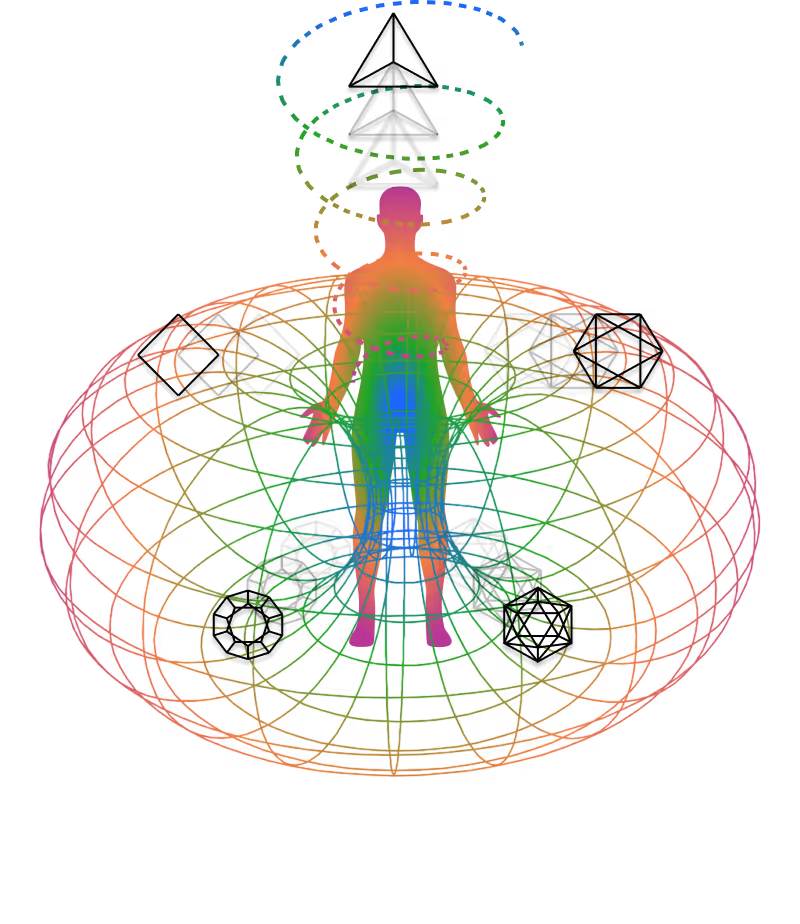
Geometric Self-Reflection - Which of the eight cubes feels most familiar or comfortable to you? Which feels most challenging or unfamiliar? How has your life experience shaped your relationship to these different modes of knowing and being?
Boundary Dimension Awareness - Reflect on moments when you've experienced the healing of boundaries—in relationships, communities, or your own consciousness. Which folded cube (5-8) was most active in these experiences? What practices or conditions enabled this boundary healing?
Hexagonal Life Mapping - Visualize your daily life as a hexagonal map. Where are the strong connections between different aspects of your life? Where are the blockages or weak connections? How might you redesign your daily patterns to create healthier boundary permeability?
Dissociation Recognition - When do you most acutely experience the feeling of separation—from yourself, others, nature, or a larger sense of meaning? How might understanding these moments through the lens of the folded cubes help you see them as opportunities for healing rather than permanent conditions?
Geometric Embodiment - How might you physically embody the tesseract geometry in your daily practice? Consider movement, spatial arrangement, or visual representations that help internalize this architecture. What would it feel like to move through your day with awareness of all eight cubes rather than being dominated by just one or two?
Lesson Materials


