Analytic Idealism and the Primacy of Consciousness
Lesson Details
This lesson explores Analytic Idealism as the ontological foundation of the SolarPunk Mandala, contrasting it with materialist paradigms and examining its alignment with both ancient wisdom traditions and contemporary science. Students will understand how consciousness-as-primary resolves the "hard problem" and creates a coherent framework for transformation.

🎙️ Related Podclass
Lesson Content
Consciousness as the Ground of Being
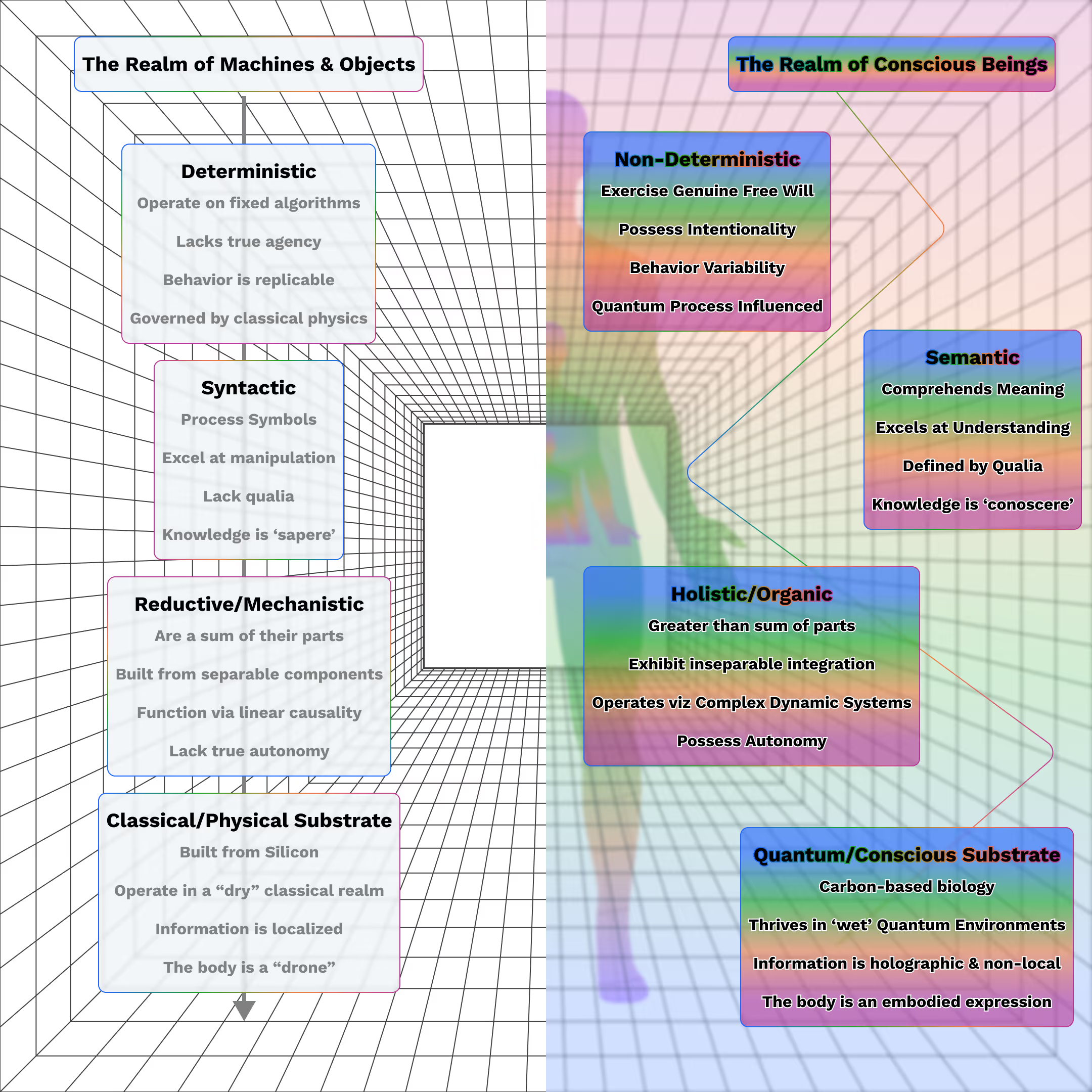
Analytic Idealism represents a radical yet empirically grounded shift in our understanding of reality's foundation. Where materialism posits that matter is primary and consciousness emerges from complex arrangements of matter, Analytic Idealism begins with the opposite premise: consciousness is fundamental, and what we call "matter" is how consciousness appears from across a dissociative boundary. For a detailed review of Bernardo Kastrup's philosophy, please review this lesson.
Resolving the Hard Problem of Consciousness
The "hard problem of consciousness" has remained unsolved within materialist frameworks because it asks how subjective experience can emerge from objective matter. This question contains a fundamental category error—treating consciousness as an effect rather than the ground of all experience. Analytic Idealism resolves this by reversing the premise: consciousness is not produced by the brain but is the primary reality within which brains (and all physical phenomena) appear as patterns.
This position doesn't deny empirical findings from neuroscience but recontextualizes them. When fMRI scans show brain activity correlating with conscious experience, Analytic Idealism interprets this not as the brain producing consciousness but as consciousness expressing itself through biological patterns. The brain becomes a receiver and translator of consciousness rather than its generator. This view aligns with quantum physics findings where observation affects what is observed, and with predictive processing neuroscience showing that perception is an active construction rather than passive reception.
What makes this resolution practical rather than merely philosophical is how it transforms our approach to transformation. If consciousness is primary, then changing our experience of reality doesn't require manipulating external conditions first but involves working with consciousness directly. This doesn't negate the importance of material conditions but places them within a larger context of conscious experience, preventing the false dichotomy between "spiritual" and "practical" approaches to change.
Mind at Large: The Singular Field of Awareness
The concept of Mind at Large (MAL) provides a coherent framework for understanding how a unified field of consciousness appears as diverse individual experiences. MAL is not a theological concept of God but a metaphysical understanding of the singular, undifferentiated field of awareness from which all experience arises. Individual minds aren't separate entities but "dissociated alters" within MAL—similar to how different personalities can coexist within a single psyche in cases of dissociative identity.
This understanding bridges scientific and spiritual perspectives. From a scientific perspective, MAL aligns with findings in quantum physics that suggest a unified field underlying apparent separation, and with systems theory that shows how complex systems emerge from simple underlying patterns. From a spiritual perspective, MAL resonates with non-dual traditions like Advaita Vedanta's concept of Brahman or Dzogchen's recognition of rigpa as the ground of being, while avoiding theological language that might alienate secular practitioners.
The power of this framework lies in its ability to honor both first-person subjective experience and third-person objective findings without reducing one to the other. When we experience wonder in nature, grief at injustice, or connection with others, we're not just having brain states—we're experiencing MAL directly. When we measure physical phenomena, we're not just observing matter—we're observing how consciousness appears from across a dissociative boundary. This unified understanding creates a foundation for transformation that honors both empirical reality and direct experience.
Dissociation as the Mechanism of Apparent Separation
Dissociation explains how the singular field of MAL appears as separate individual minds and a seemingly external physical world. In psychology, dissociation describes how consciousness can partition itself while maintaining underlying unity—like different personalities sharing one body. The SolarPunk Mandala applies this understanding to the fundamental nature of reality: what we experience as separate minds and external matter are dissociated expressions of MAL.
This understanding transforms how we approach healing and transformation. Rather than trying to "create" connection or "build" unity (as if they don't already exist), our work becomes one of healing dissociation—dissolving the boundaries that create the illusion of separation. The Dissociation Lens Framework requires all practices to address how they heal specific dissociation boundaries, preventing approaches that reinforce separation while claiming to promote connection.
For example, a community garden project operating within Analytic Idealism would not just focus on food production (material outcome) or community building (social outcome) but would explicitly address how the project heals the dissociation between humans and nature, between individual and collective needs, and between consciousness and its physical expression. This might include practices like collective grounding before gardening, rituals that honor the intelligence of plants, and decision-making processes that dissolve the boundary between "doers" and "receivers."
The framework recognizes that dissociation isn't inherently pathological—it's a necessary mechanism that allows consciousness to experience itself from multiple perspectives. The goal isn't to eliminate all boundaries but to create what the framework calls "boundary permeability"—boundaries that allow circulation while maintaining necessary differentiation. This understanding prevents both spiritual bypassing (ignoring real boundaries and power dynamics) and materialist reductionism (denying the reality of consciousness).
Methodological Openness with Ontological Clarity
The Mandala framework maintains a crucial balance: ontological clarity about consciousness as primary while remaining methodologically open to multiple approaches and empirical research. This means that while the framework holds consciousness as fundamental, it doesn't require practitioners to adopt specific metaphysical beliefs or reject scientific methodologies that may operate with different assumptions.
This principle is revolutionary in bridging seemingly incompatible worldviews. Secular practitioners can engage with the framework's practical protocols without accepting its metaphysical claims. Religious practitioners can find their traditions honored while connecting to a larger field of consciousness beyond specific doctrines. Scientific researchers can test the efficacy of consciousness practices without resolving the metaphysics debate.
The Dissociation Lens Framework operationalizes this principle by requiring all protocols to include questions about how they address dissociation boundaries, regardless of one's metaphysical framework. For example, a trauma healing protocol might be effective whether practitioners believe consciousness is emergent from matter or primary to it—but the protocol must still address how it heals the dissociation between mind and body, individual and community, safety and growth.
This approach creates what the framework calls "convergence without compromise"—different perspectives can converge on practical actions while maintaining their distinct metaphysical understandings. A community addressing food insecurity might include members who see consciousness as primary and members who see it as emergent, but all can agree that collective gardening practices that honor the intelligence of soil and plants create more resilient food systems. The framework provides a "container" for this convergence through its geometric architecture and practical protocols.
🤌 Key Terms
Analytic Idealism - The philosophical position that consciousness is the sole ontological primitive, not an emergent property of matter. This view resolves the "hard problem" of consciousness by honoring the primacy of direct experience and aligning with findings in quantum physics, predictive processing neuroscience, and the phenomenology of non-ordinary states of consciousness.
Mind at Large (MAL) - The singular, undifferentiated field of awareness from which all experience arises. Individual minds are understood as dissociated alters within MAL—akin to personalities in a single psyche—each with their own boundary of experience. The physical world is the extrinsic appearance of MAL's inner dynamics.
Dissociation Lens Framework - A practical protocol requiring all practices to address how they heal dissociation boundaries between individual experience and MAL. It includes Core Questions, Boundary Medicine identification, and MAL Reflection requirements to prevent philosophical-materialist slippage and spiritual bypassing.
Methodological Openness - The Mandala's commitment to engaging with empirical research and multiple metaphysical frameworks while maintaining ontological clarity about consciousness as primary. This allows the framework to bridge secular and sacred domains without compromising its foundation.
Boundary Permeability - The design principle that healthy boundaries allow circulation while maintaining integrity. In the context of Analytic Idealism, this means creating boundaries that dissolve when appropriate while maintaining necessary differentiation—reflecting MAL's dynamic nature as both unified and diverse.
🤌 Reflection Questions
Reflect on key questions from this lesson in our Exploration Journal.

Materialism vs. Idealism Mapping - Reflect on moments in your life when you've operated from a materialist perspective (matter as primary) versus an idealist perspective (consciousness as primary). How did these different frameworks shape your actions, relationships, and sense of possibility?
Dissociation Boundary Awareness - Identify one area of your life where you experience strong dissociation (separation) between aspects that might actually be connected. For example, between your work and personal life, between your mind and body, or between yourself and nature. How might viewing this through the lens of MAL change your approach to healing this dissociation?
Methodological Practice - Consider a practical challenge you're currently facing. How might you address it while maintaining "methodological openness with ontological clarity"? What actions would honor consciousness as primary while remaining accessible to people with different metaphysical beliefs?ana
Lesson Materials