

The SolarPunk Mandala as Ontological Architecture
Lesson Details
This foundational lesson introduces the SolarPunk Mandala as a living geometry of belonging that begins with ontological ground—what is real—and progresses through epistemology, ethics, and praxis. Students will understand how the Mandala's core insight that consciousness is primary shapes its entire architecture and practical applications.

🎙️ Related Podclass
Lesson Content
The Mandala as Ontological Framework
The SolarPunk Mandala is not merely a theoretical construct but a living geometry of belonging that begins with a single transformative insight: consciousness is the sole ontological primitive. This foundational understanding shapes everything that follows in the framework. Unlike materialist paradigms that view consciousness as an emergent property of matter, the Mandala begins with what's called Analytic Idealism—the proposition that Mind at Large (MAL) is the singular, undifferentiated field of awareness from which all experience arises.
Consciousness as the Sole Ontological Primitive
This foundational premise represents a radical inversion of conventional materialist paradigms that dominate contemporary thought. In materialism, consciousness is viewed as an emergent property of complex material arrangements—essentially a byproduct of brain activity. Analytic Idealism, however, begins with the primacy of consciousness itself as the fundamental ground of all reality. This position isn't new—it echoes ancient wisdom traditions from Advaita Vedanta to Buddhist phenomenology—but it's expressed through a contemporary lens that engages with modern science and practical application.
The concept of Mind at Large (MAL) resolves what philosophers call "the hard problem of consciousness"—how subjective experience arises from objective matter. By reversing the premise and placing consciousness first, this problem dissolves. Instead of asking how matter produces consciousness, we explore how consciousness appears as matter through what the framework calls "dissociation boundaries." Individual minds aren't separate entities but "dissociated alters" within the singular field of MAL, much like different personalities can exist within a single psyche in cases of dissociative identity.
This ontological position doesn't reject empirical science but recontextualizes it within a framework that honors direct experience as irreducible. Quantum physics findings that observation affects what is observed, and predictive processing neuroscience showing that perception is an active construction rather than passive reception, align with this consciousness-first perspective. The Mandala thus stands at the intersection of ancient wisdom and cutting-edge science, providing a coherent foundation that transcends the false dichotomy between spirituality and rationality.
Integration of Metaphysical Insights with Practical Application
The Mandala's power lies in its integration of profound metaphysical insights with practical application. It doesn't remain abstract but operationalizes its ontology through a six-part system that moves from what is real (ontology) to how we know (epistemology), how we act (ethics), and how we build, remember, and integrate (praxis).
The acumen of the SolarPunk Mandala is its refusal to remain in the realm of abstract philosophy. While many consciousness frameworks provide profound insights but fail to translate them into practical action, the Mandala creates a complete pathway from metaphysical ground to daily practice. This six-part system (ontology, epistemology, ethics, praxis, remembrance, integration) ensures that profound insights about the nature of reality directly inform how communities respond to crises, design sustainable systems, and cultivate personal wellbeing.
This integration prevents what spiritual traditions often call "spiritual bypassing"—using transcendent insights to avoid addressing concrete suffering. The framework's practical orientation means that understanding consciousness as primary directly impacts how we organize food systems, design housing, resolve conflicts, and create governance structures. For example, recognizing that individual minds are dissociated alters within MAL transforms how we approach community dialogue—moving from debate to co-creation, from competition to collaboration, from separation to belonging.
The framework maintains what it calls "methodological openness" while holding ontological clarity. This means it can engage with empirical research and multiple metaphysical frameworks while maintaining its core insight about consciousness as primary. This allows the Mandala to bridge secular and sacred domains without compromising its foundational principles, making it accessible to atheists, spiritual seekers, and devotees alike.
The Geometric Architecture of Transformation
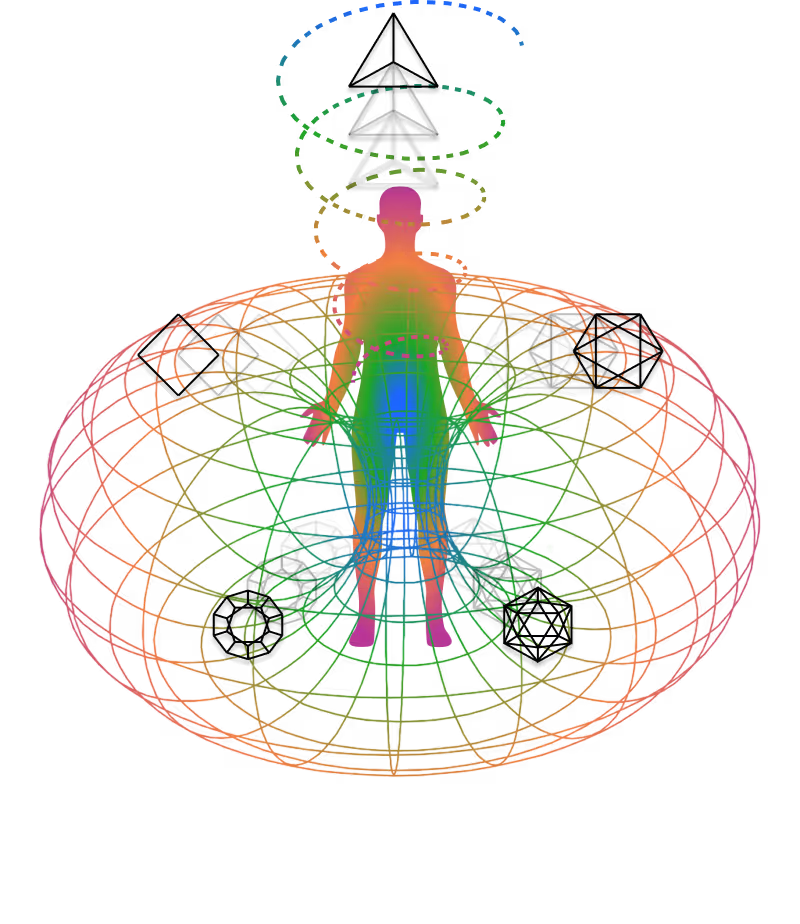
At its geometric heart is the Embodied Foundations Core (Ø)—the dissociative boundary of Mind at Large experiencing itself—a null point that enables all other perspectives. From this core unfolds the tesseract structure with its eight cubes of epistemic access, sixteen vertices of vocation, twenty-four faces of transformation interfaces, and thirty-two edges of practice.
The Mandala's geometric architecture isn't arbitrary symbolism but a precise mapping of how consciousness manifests as multi-dimensional reality. The Embodied Foundations Core (Ø) represents what quantum physicists might call a "singularity point"—a null position that enables all other perspectives to emerge. This core consists of four essential dimensions (Nourishment, Cleansing, Restoration, Movement) that ground all transformation in physical reality.
From this core emerges the tesseract—a four-dimensional hypercube that serves as a cognitive prosthetic for navigating reality's complexity. The eight cubes of epistemic access represent distinct modes of knowing and being, ranging from subjective interiority (UL) to objective exteriority (UR), from individual experience to collective systems (LR), and from cultural meaning to intersubjective dialogue (LL). The folded cubes (5-8) represent boundary dimensions where transformation occurs—interfaces where consciousness heals its own dissociations.
This geometric precision provides practical tools for community transformation. The sixteen vertices represent unique vocations at the intersection of pathways and elements; the twenty-four faces map interfaces between spatial and functional dimensions; the thirty-two edges chart pathways of practice. This architecture doesn't just describe reality—it provides a navigational system for moving through it, with the Embodied Foundations Core ensuring that all transformation remains grounded in physical reality. The geometry thus becomes a living language that communities can use to design systems, resolve conflicts, and cultivate wellbeing.
Preventing Philosophical Slippage Through Embodied Thresholds
This architecture prevents what the framework calls "philosophical-materialist slippage" and "spiritual bypassing" by establishing that no pathway or protocol can be fully activated when any embodied foundation (Nourishment, Cleansing, Restoration, Movement) scores below 2 on a 1-5 scale. The Mandala thus bridges the highest metaphysical understanding with the most practical concerns, creating a unified field where spiritual realization and material conditions aren't separated but held in geometric harmony.
The Embodied Threshold Rule represents one of the framework's most revolutionary insights—its refusal to separate spiritual practice from material conditions. Many consciousness frameworks, whether ancient or contemporary, often collapse into abstraction when faced with real-world challenges like hunger, housing insecurity, or trauma. The Mandala prevents this by establishing a non-negotiable threshold: no pathway or protocol can be fully activated when any foundation scores below 2 on a 1-5 scale.
This threshold creates what the framework calls "boundary medicine"—practices specifically designed to heal the dissociation between spiritual and material domains. For example, when a community faces food insecurity (Nourishment foundation below 2), the framework doesn't offer transcendent meditations as primary intervention but focuses on practical food systems while simultaneously addressing the dissociation between individual survival and collective care. This prevents "philosophical-materialist slippage"—where consciousness frameworks collapse into materialism when confronted with concrete challenges.
Simultaneously, the threshold prevents "spiritual bypassing"—using metaphysical insights to avoid addressing material conditions. The framework recognizes that attempts to practice higher-dimensional consciousness work without stable foundations lead to burnout, disillusionment, and spiritual consumerism. By requiring foundation stability first, the Mandala ensures that spiritual practice emerges from embodied wholeness rather than compensating for fragmentation.
This integration creates what the framework calls a "unified field of belonging"—where spiritual realization and material conditions aren't separated but held in geometric harmony. When all four foundations are stable, communities can access the full spectrum of consciousness practices without bypassing or collapsing into materialism. This unified field becomes the ground for what the Mandala calls "co-creative participation"—not just surviving or even thriving, but actively participating in consciousness's ongoing self-expression through form.
🤌 Key Terms
Analytic Idealism - The philosophical position that consciousness is the sole ontological primitive, not an emergent property of matter. This view resolves the "hard problem" of consciousness by honoring the primacy of direct experience.
Mind at Large (MAL) - The singular, undifferentiated field of awareness from which all experience arises. Individual minds are understood as dissociated alters within MAL—akin to personalities in a single psyche.
Embodied Foundations Core (Ø) - The geometric and functional center of the Mandala, representing the dissociative boundary where MAL experiences itself. It consists of four essential dimensions: Nourishment, Cleansing, Restoration, and Movement.
Dissociation Boundary - The interface where MAL partitions into individual alters with their own boundaries of experience. This boundary is not a flaw but a necessary condition for consciousness to experience itself.
Tesseract - A four-dimensional hypercube used as a cognitive prosthetic to map the eight cubes of epistemic access through which reality appears as multi-perspectival.
🤌 Reflection Questions
Reflect on key questions from this lesson in our Exploration Journal.

Personal Ontology Mapping - Reflect on your own understanding of what is fundamentally real. How has your view of consciousness and matter evolved throughout your life? Where do you currently stand on the spectrum from materialism to idealism?
Embodied Foundations Assessment - Consider the four embodied foundations (Nourishment, Cleansing, Restoration, Movement) in your own life. Rate each on a scale of 1-5. How does the stability or instability of these foundations affect your capacity for higher-order thinking and spiritual practice?
Boundary Awareness - When do you experience the clearest sense of connection to something larger than yourself? When do you feel most separate or dissociated? What conditions (internal or external) create these different states?
Lesson Materials


