

The Axiological Axis as Regenerative Ethics
Lesson Details
This foundational lesson introduces the Axiological Axis as one of the four ethical dimensions through which the Tesseract orients not just knowing but becoming. Students will understand how this axis asks "How regenerative is the system?" and serves as the foundation for values-based transformation in sustainability and spirituality.

🎙️ Related Podclass
Lesson Content
The Axiological Axis as Ethical Compass
The Axiological Axis represents one of the four orthogonal ethical dimensions through which the Tesseract orients transformation. Unlike conventional ethics that focus on individual moral choices, the Axiological Axis examines systems as expressions of underlying values—asking not just "What should I do?" but "What kind of world are we creating through our collective choices?"
This axis is anchored in the rhizomatic expression of ECONOMICS + ECOLOGY + SHELLS, revealing how our economic systems, ecological relationships, and built environments are not separate domains but interconnected expressions of our deepest values. When these domains are integrated through regenerative values, they create what the framework calls "symbiotic systems" that heal rather than harm. When fragmented through extractive values, they generate what the document terms "necrocene patterns"—death-driven logic of extraction and dissociation.
The Axiological Axis requires Nourishment as its essential embodied foundation dependency, revealing a profound insight: communities cannot sustain regenerative values when people are hungry, insecure, or disconnected from life-sustaining resources. Values aren't abstract ideals but emerge from embodied experience—when people's basic needs are met with dignity, they can envision and create systems that honor life rather than exploit it.
Nourishment as Ethical Ground
Nourishment functions as the embodied foundation that makes axiological transformation possible. This foundation encompasses the cyclical processes of taking in, transforming, and circulating sustenance at individual and collective levels—physical nourishment (food, water, air), emotional nourishment (connection, belonging), and cultural nourishment (stories, meaning).
When Nourishment is fractured, values systems collapse into extractive logic—taking without giving back, consuming without reciprocating. When integrated, Nourishment becomes reciprocity—the recognition that to receive nourishment is to participate in a cosmic exchange where consciousness feeds itself through form. This foundation heals the dissociation between individual survival and collective care, revealing that no life exists in isolation.
The Embodied Threshold Rule applies directly to axiological work: no pathway or protocol can be fully activated when Nourishment scores below 2 on a 1-5 scale. This principle prevents spiritual bypassing by ensuring that higher-dimensional value work remains grounded in physical reality. It also prevents "moralizing materialism" by recognizing that ethical systems cannot be sustained when people's basic needs are unmet.
The Four Value Orientations
The Axiological Axis recognizes four fundamental orientations that shape our relationship to systems and resources:
Extractive Orientation views resources as infinite and relationships as transactional. This orientation sees nature as dead inventory to be converted to profit, communities as markets to be exploited, and individuals as human capital to be optimized. It generates what the framework calls "necrocene patterns"—sacrifice zones, death-worlds, and externalized costs that appear efficient but are ultimately suicidal.
Sustainable Orientation seeks to minimize harm while maintaining current systems. This orientation recognizes planetary boundaries and social limits but often operates within the same extractive framework, merely slowing down the destruction rather than transforming the underlying values. It generates "greenwashing" and "sustainability theater" that feel progressive but maintain core patterns of exploitation.
Regenerative Orientation actively rebuilds and enhances life systems. This orientation sees nature as conscious intelligence, communities as living networks, and individuals as expressions of collective wisdom. It generates "symbiotic systems" that heal ecological damage, restore community relationships, and honor the intrinsic value of all beings. This orientation requires stable Nourishment foundations to sustain its vision.
Participatory Orientation recognizes that humans are co-creators within a conscious universe. This orientation moves beyond stewardship to participation—seeing human activity as part of nature's self-expression rather than separate from it. It generates "participatory consciousness" where individuals recognize themselves as both distinct expressions and integral parts of the same field of awareness. This orientation represents the highest expression of the Axiological Axis.
These orientations aren't rigid categories but fluid expressions that communities move between based on their Nourishment stability and dialectical velocity. A community with unstable foundations might operate from extractive orientation during crisis while maintaining regenerative values during stability—a dynamic that the framework honors rather than judges.
Dissociation Lens for Value Systems
The Dissociation Lens Framework operationalizes axiological transformation by requiring all practices to address how they heal specific dissociation boundaries related to value systems. This prevents values work from remaining abstract philosophy and ensures it translates into concrete action.
The core questions for axiological work are:
- How does this practice address the dissociation between economic value and ecological value?
- How does this practice heal the boundary between individual prosperity and collective wellbeing?
- How does this practice dissolve the separation between human systems and natural systems?
These questions reveal the hidden dissociations that maintain extractive systems. For example, conventional economics dissociates monetary value from ecological value, creating systems where profit can increase while ecosystems collapse. Regenerative economics dissolves this boundary by recognizing that true wealth includes healthy soil, clean water, and strong communities.
The framework recognizes that values transformation requires what it calls "convergence without compromise"—different perspectives can converge on practical actions while maintaining their distinct metaphysical understandings. A community addressing food systems might include members who see consciousness as primary and members who see it as emergent, but all can agree that collective farming practices that honor soil intelligence create more resilient food systems.
This methodological openness with ontological clarity allows the framework to bridge seemingly incompatible worldviews while maintaining its core insight that regenerative values emerge from recognizing our fundamental interdependence.
🤌 Key Terms
Axiological Axis - One of the four ethical dimensions through which the Tesseract orients knowing and becoming. It asks "How regenerative is the system?" and is anchored in ECONOMICS + ECOLOGY + SHELLS, with Nourishment as its essential embodied foundation.
Regenerative Systems - Systems designed to actively rebuild and enhance life rather than merely sustain or extract. These systems operate on principles of reciprocity, circularity, and symbiosis rather than linear extraction and waste.
Nourishment Foundation - The embodied foundation of cyclical processes of taking in, transforming, and circulating sustenance at individual and collective levels. When fractured, it becomes extraction; when integrated, it becomes reciprocity.
Dissociation Lens Framework - A practical tool requiring all practices to address how they heal dissociation boundaries between different domains of value. For axiological work, this focuses on boundaries between economic, ecological, and social value systems.
Symbiotic Commonwealth - The ultimate goal of axiological transformation—a world where power, resources, knowledge, and meaning flow through networks rather than hierarchies, creating conditions for all life to flourish.
🤌 Reflection Questions
Reflect on key questions from this lesson in our Exploration Journal.

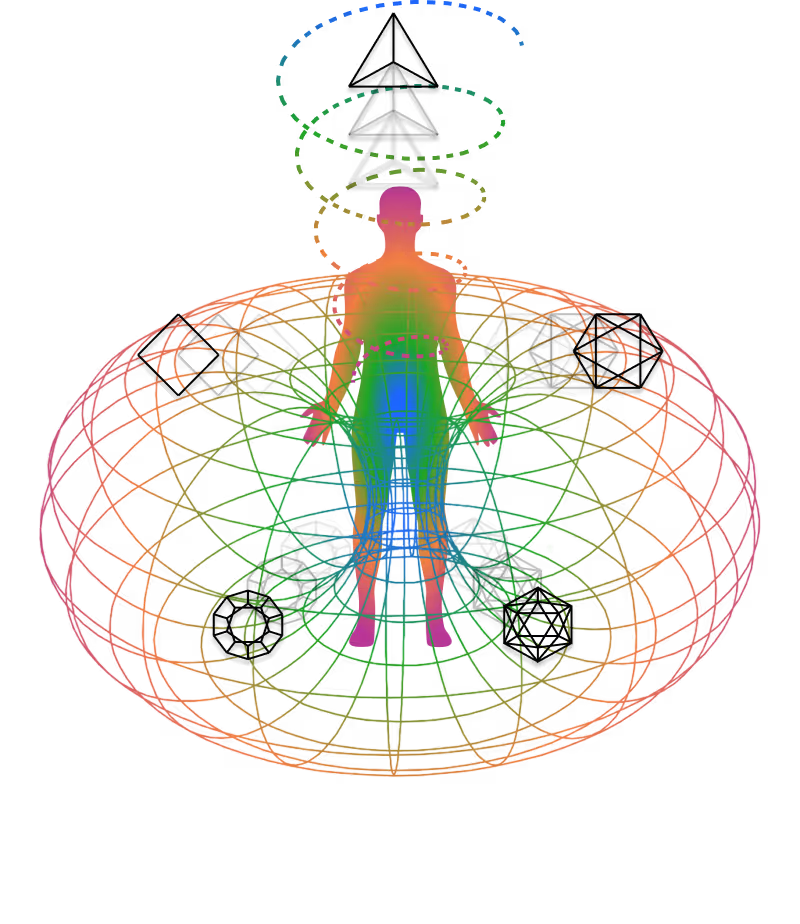
Value System Mapping - Map your personal relationship to the four value orientations (extractive, sustainable, regenerative, participatory). In which areas of your life do you operate from each orientation? What conditions support or challenge each orientation?
Nourishment Assessment - Assess your own Nourishment foundation on a scale of 1-5. How does the stability or instability of this foundation affect your capacity to maintain regenerative values when faced with challenges?
Dissociation Recognition - Identify one value dissociation in your life or community (e.g., between stated values and actual practices, between individual and collective good). How might healing this dissociation transform your relationship to systems and resources?
Ethical Grounding - Reflect on a time when your values were tested by material conditions. How did your embodied experience influence your ethical choices? What would have supported you to maintain your values during that challenge?
Future Vision - Imagine a community where regenerative values are fully integrated into economic systems, ecological relationships, and built environments. What does daily life feel like in this community? How do people make decisions about resources and relationships?
Lesson Materials


